

The FIFA World Cup 2026 is returning to North America for the first time since 1994. The anticipation is reaching fever pitch, not just because of its return to North America soil but also because of the size of the tournament scheduled for 2026.
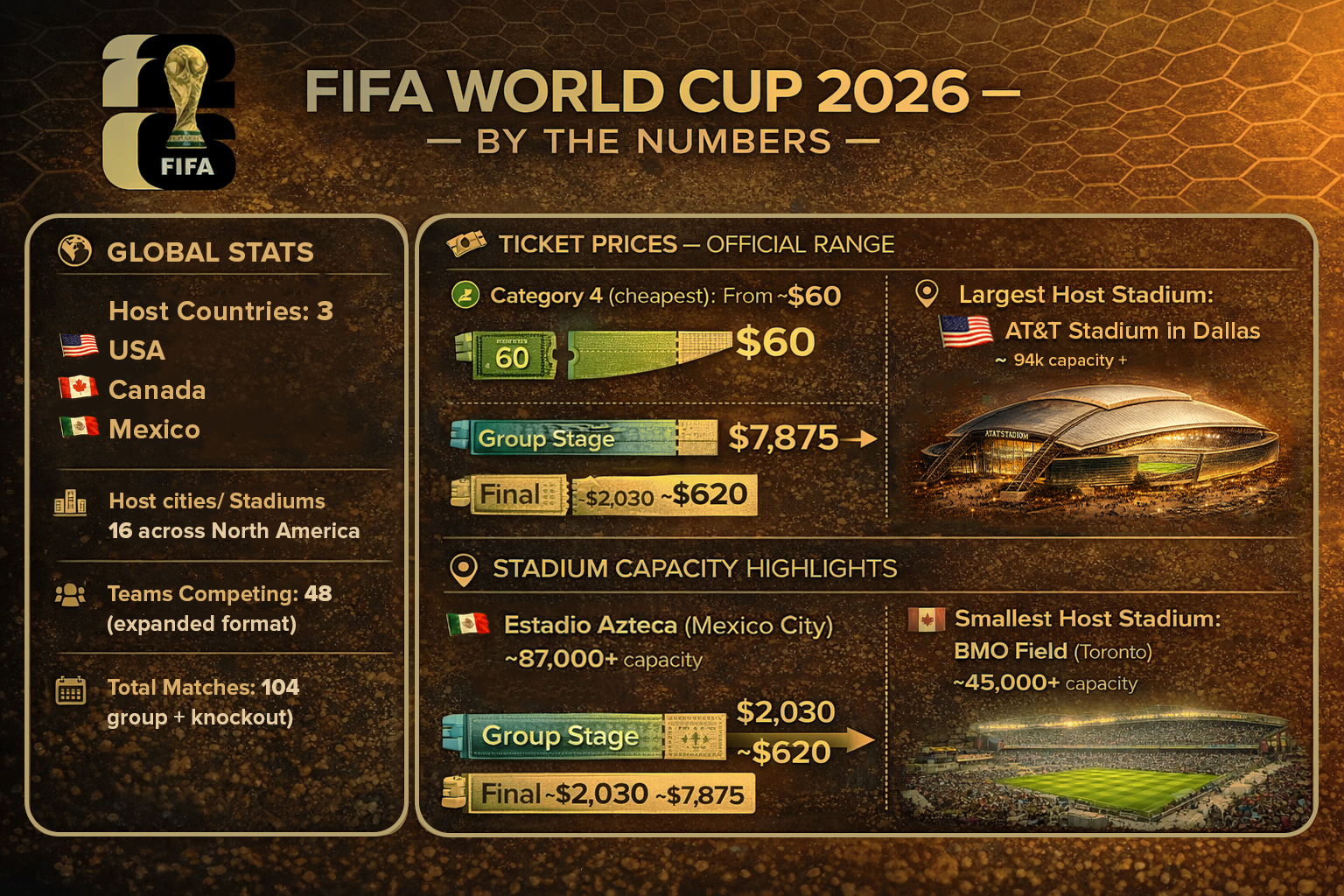
The FIFA World Cup 26 is about to be the biggest World Cup in history – so far – with 48 teams participating in 104 matches in16 cities spanning three countries.
And for the first time in history, the Cup will be hosted by three countries. The USA, Canada, and Mexico will host matches in 16 different cities starting June 11 to July 19, 2026.
FIFA is already seeing unprecedented demand from the fans, as they received 20 million ticket requests before the general sale phase has even begun.
Whether you’re hoping to catch a game or two in Vancouver, attend the final match at MetLife Stadium, or witness teams like Brazil, Argentina, and England in action, it won’t be easy to get the tickets. You’ll need both patience and a solid strategy for getting access to World Cup games.
This comprehensive guide covers everything you need to know about FIFA World Cup 2026 tickets: how to buy them through official channels, what different categories and rounds include, the complete schedule for the USA, and useful tips that increase your chances of experiencing this historic tournament.
This World Cup 2026 Guide Offers:
- Tournament Overview & Key Facts
- How to Buy Tickets
- Price Breakdown by Category
- All 16 Host Cities & Stadiums
- USA National Team Schedule
- Key Dates Timeline
- Tips & Common Mistakes
- Frequently Asked Questions
If you want to learn more how ticket prices work, click HERE. You can also learn in detail how to buy tickets HERE. Browse our guide to US host cities to see all 11 US cities hosting World Cup 26.
Tournament Overview
The 2026 FIFA World Cup is already creating a lot of buzz, mostly because it’s already looking like a massive spectacle that will be taking place across three different countries.
Another interesting thing is that the tournament is expanding its size for the first time. Instead of 32, the tournament will have 48 teams competing for a chance to lift the FIFA World Cup Trophy.
Quick Facts
| Fact | Detail |
| Dates | June 11 – July 19, 2026 |
| Total Matches | 104 |
| Teams | 48 |
| Host Countries | USA (11 cities), Mexico (3), Canada (2) |
| Opening Match | Mexico vs. South Africa – Estadio Azteca |
| Final | MetLife Stadium, New Jersey – July 19, 3:00 PM ET |
| Semi-Finals | AT&T Stadium (Dallas) & Mercedes-Benz Stadium (Atlanta) |
| USA Group Matches | SoFi Stadium (LA) & Lumen Field (Seattle) |
Why This World Cup Is Historic
Every Cup pushes a few records, but this tournament goes a step further and sets new precedents for the overall competition.
The expansion from 32 to 48 teams means soccer fans will get a chance to see nations competing that have never qualified before. For example, Curaçao, Jordan, Cape Verde, and Uzbekistan are all hopefully making their World Cup debuts.
Another novelty is the extension of the knockout stage with the inclusion of a Round of 32. What this means is that the teams that have reached the final will get to play eight matches, instead of seven, which was the case in previous tournaments.
The Expanded 48-Team Format Explained
Because the tournament is switching to a new format, the group phase will now feature 12 groups of four instead of the previous 8 groups of four teams.
However, each team will get to play three group stage matches, just like before.
But despite that, there were some changes to the rules for advancing to subsequent phases that affect the path teams will take towards the final match.
In each group, the top two teams will automatically advance to the Round of 32, where they will form a group of 24 teams. The eight best third-place finishers also move forward, creating compelling scenarios where teams must calculate goal differential and results across all groups.
This change increased the total number of matches played from 64 to 104, which is a 62.5% increase. That means that even more fans will get to experience the magic of the World Cup, but it also might create tension when it comes to acquiring tickets.
USA to Play in Group D
The FIFA World Cup 26 draw took place at the beginning of December 2025 at the Kennedy Center in Washington, D.C.
During the draw, it was revealed that the United States will play its matches as part of Group D. Besides the USA, Group D also has Paraguay, Australia, and the winner of UEFA Playoff C. The exact team will be decided in a match in March 2026, with possible competitors being Turkey, Romania, Slovakia, or Kosovo.
The US men’s national soccer team will play all three of their group matches on home soil. Two will be at SoFi Stadium in Los Angeles, and one at Seattle’s Lumen Field stadium.
How to Buy Tickets
You can find a list of all 104 matches and buy World Cup tickets HERE.
The FIFA ticketing system includes multiple phases of ticket sales, and each comes with different processes and access requirements.
Here’s what you need to know about securing your seat at the world’s biggest sporting event.
Official FIFA Portal
The only guaranteed legitimate source for FIFA World Cup 2026 tickets is the official FIFA website.
Any other seller claiming to have “guaranteed” tickets before general sale is either reselling (at massive markups) or running a scam.
However, to access the official portal, you must first create a free FIFA ID account. This account is connected to your email, so it’s the gateway to all tickets and purchases made using the FIFA account. It’s an easy process which takes less than five minutes. We would advise you to complete it before tickets go on sale.
Furthermore, all 2026 World Cup tickets are mobile-only. They will be delivered through the official FIFA app once purchased. There are no physical tickets or print-at-home options. The mobile-only approach ensures there are no screenshots or unauthorized transfers using a unique QR code that’s updated regularly.
The Random Selection Lottery
As mentioned, there are several sale phases for this World Cup. Right now, we are in the middle of the Random Selection Draw, which is the third official phase and the first time the general public can acquire tickets after knowing the full match schedule and group assignments.
It started in the middle of December and will last until January 13. The next phase will be Last-Minute Sales Phase.
Key Details
- Open: December 11, 2025 – January 13, 2026 (11:00 AM ET)
- Entry method: Lottery system
- Results: Allotments will be announced in February 2026
- Payment: Winners will be charged after selection
- IMPORTANT: This is NOT a first-come, first-served system, that’s the Last-Minute phase. In Random Selection Draw, fans who are applying at 11:00 AM on December 11 have the same chances of getting tickets as those applying at 10:59 AM on January 13. FIFA randomly selects winners from the entire pool of applicants after the entry period closes.
How the Lottery Works:
You apply for specific matches by selecting your preferred ticket category (1-4) and quantity (up to 4 tickets per match, maximum 40 tickets total per household). FIFA defines “household” as the postal address in your ticketing account, meaning multiple family members at the same address share a collective limit.
Here’s the critical tip most people miss: Check the “accept downgrade” box when applying. If your requested Category 1 tickets are unavailable, FIFA can allocate Category 2, 3, or 4 instead. Without checking this box, your application gets rejected entirely rather than receiving an alternative. You can always decline tickets after selection if the downgrade is unacceptable.
Winners receive notification in February 2026 with a specific purchase window—typically 2-3 weeks. During this time, you must complete payment for ALL allocated tickets or decline entirely. FIFA doesn’t allow cherry-picking; it’s an all-or-nothing acceptance.
What’s Coming Next
Here’s a quick overview of the next sales phases for World Cup 2026 tickets.
Bank of America Presale – February 10, 2026
Bank of America cardholders get a huge benefit of exclusive access to a pre-sale window. Right now, it’s not disclosed which exact card types qualify and purchase limits will be available, but we expect FIFA to announce it closer to the date of the pre-sale.
This phase starts and ends typically quite faster than lottery draws. But still, you should count on it to last for a longer time because of the time it’s needed to submit applications.
General Sale – Spring 2026
The main part of ticket sales is the general sale phase. The first-come, first-served sales phase opens sometime in spring 2026 (exact date TBA). That’s all we know for now.
This represents your best chance for last-minute tickets, though availability will be extremely limited for premium matches like USA games, the final, and semifinals. Unlike the lottery, general sale rewards speed. Tickets go to whoever clicks “purchase” first when inventory drops.
Alternative Methods
If you fail to acquire tickets using the standard channels and the official FIFA website, there are some other ways to get them that are still safe and reliable.
FIFA Resale Marketplace
Besides the official portal, FIFA also operates a resale marketplace. Essentially, it’s an official resale platform where lottery winners can list unwanted tickets at face value.
This marketplace launches after general sales conclude. It’s a legitimate secondary option without markup. You’ll need a FIFA ID to access the marketplace, and tickets move quickly when posted.
Hospitality Packages
For those with deeper pockets, hospitality packages starting at $1,350 USD for single matches offer premium seating with food, beverages, parking, and exclusive lounge access. Granted, it can be quite expensive, but they offer guaranteed availability when standard tickets sell out.
Secondary Markets
Sites like TicketCenter and similar list tickets, but please understand what you’re buying. These are intermediary platforms where independent sellers sell tickets at a slightly higher price than the usual official ticket seller (in this case, FIFA). And fans face other concerns that can be worse than an elevated price. Risks include authenticity concerns, potential invalidation if FIFA detects unauthorized transfers, and zero recourse if the seller defaults.
That is why it’s very important to pick only trusted secondary marketplaces such as this one.
World Cup 26 Ticket Prices
Theres’s a four-category pricing system in place that distinguishes seats by their location, as well as the changes in demand and match importance. For example, the Cup final is far more important than a simple group match, and the closer we are to the event, the higher the price is going to be. That’s why it’s smart to study the categories a bit before delving into the matter of obtaining FIFA World Cup tickets.
The 4-Category System
Like we said, there’s a 4-category system, where Category 1 covers the most sought-after seats, and Category 4 are the ones that are easier to find and generally cheaper.
| Category | Location | Group Stage Price |
| Category 1 | Lower bowl, center pitch | $300 – $620 |
| Category 2 | Upper/lower sides | $200 – $350 |
| Category 3 | Upper tier, behind goals | $140 – $250 |
| Category 4 | Upper corners | $60 – $105 |
Category 1 seats position you close to the action with optimal sightlines. These are often priced higher than other categories, but they are also the ones that are most worth it.
Category 2 is the middle ground with excellent value. In simple terms, you’re still close enough to feel the atmosphere, but you shaved 30-40% off the price that you’d pay for Category 1. These seats are typically booked the fastest – even faster than Category 1.
Category 3 are positions right behind the goals in upper sections. The views are acceptable but not ideal. However, these sections are also the loudest, particularly when national fans cluster together.
Finally, Category 4 represents the “budget” option, though “budget” is relative at $60-$105. Corner seats in upper sections have limited pitch visibility but you’re still in the stadium and you’re getting the whole experience, so it’s worth it.
Prices by Round
Please bear in mind that these are estimates of prices for tickets that are yet to go on sale. As the tournament approaches, it’s very likely that the prices will start to climb.
| Round | Cheapest | Most Expensive |
| Group Stage | $60 | $620 |
| Round of 32 | $80 | $800 |
| Round of 16 | $120 | $1,200 |
| Quarter-Finals | $150 | $1,500 |
| Semi-Finals | $200 | $2,500 |
| Final | $300 | $6,730 |
It’s not unheard of to see a Category 1 ticket that costs $620 for group stage action jumping to $6,730 for the final. That’s more than a 10x increase for the same seat but it’s the final – the peak of demand. But that is the reality of dynamic pricing.
Dynamic Pricing Explained
FIFA uses dynamic pricing that adjusts based on real-time demand. Think of it like airline tickets: prices fluctuate between sale phases depending on how many people want to attend specific matches.
Less popular matchups may even get a drop in price. A match during the group stage between smaller nations in Categories 3-4 could drop from $140 to $80 if demand is smaller than FIFA expected.
At the same time, sought-after games of national teams from the USA, England, Brazil, Argentina, or Spain will almost certainly go up.
The USA opener against Paraguay already lists at $2,735+ for Category 4 seats, which is insanely high compared to the $60-$105 standard range for that tier for other countries and games.
This dynamic system means that being early with application during lottery phases can often secure better prices than during general sale. And even if general sale gives you more options, it’s still pricier than obtaining it during the early phases.
The $60 Ticket Reality
FIFA announced at the end of 2025 that each match will offer tickets at $60 to national team supporters. That’s huge for the fans, as some fans wait years to get their hands on a ticket or two for the event. As announced, FIFA will allocate a certain number of tickets at this pricing to participating member associations. And even though this sounds fantastic, there are a few catches to be wary of.
The first major hiccup is that you only have around 400-500 tickets per match available at this price. They are quickly distributed among qualified supporters of both teams. The next issue is eligibility.
Essentially, to qualify, you typically need official supporter membership with your national federation, attendance history at multiple qualifying matches, and residency in the country you’re supporting. This is just the gist of it – there are other requirements that are asked of you.
And finally, the demand is often too great – for US matches, American fans will request tens of thousands of tickets for players who meet all the criteria for allocated tickets. That means that this is great for smaller countries, but sought-after matches for popular teams are not going to be easy to handle.
The Host Cities & Stadiums
The 2026 World Cup is unique in the sense that it has 3 host countries for the first time ever. These three are Canada, the USA, and Mexico.
Over the tournament’s 39 days, 104 matches will be played in 16 venues total – all these venues offering unique experiences, cultures, and challenges. Here’s what you need to know about every host city and its stadium.
USA Host Cities
Here’s a table showing the US host cities, stadiums, and a few key facts about every single one of them.
| City | Stadium | Capacity | Key Matches |
| New York/NJ | MetLife Stadium | 82,500 | FINAL (July 19) |
| Los Angeles | SoFi Stadium | 70,240 | USA Group (2) + QF |
| Dallas | AT&T Stadium | 94,000 | Semi-Final (July 14) |
| Atlanta | Mercedes-Benz | 75,000 | Semi-Final (July 15) |
| Miami | Hard Rock | 65,000 | QF + Third-Place |
| Seattle | Lumen Field | 69,000 | USA Group (1 match) |
| San Francisco | Levi’s Stadium | 70,909 | Group + Knockout |
| Houston | NRG Stadium | 72,220 | Group + Knockout |
| Kansas City | Arrowhead | 76,416 | Group + Knockout |
| Philadelphia | Lincoln Financial | 69,796 | Group + Knockout |
| Boston | Gillette Stadium | 65,878 | Group + Knockout |
MetLife Stadium in New Jersey will host the biggest match of the tournament, which is the final match on July 19.
The stadium is located in East Rutherford, which is about 8 miles from Manhattan. The stadium is quite impressive because of its 82,500-seat capacity.
Another iconic venue is LA’s SoFi Stadium. The stadium in Los Angeles is brand new and state-of-the-art with a translucent roof and 360-degree video board. The USA opener here will be electric with massive local support.
Other noteworthy host cities and stadiums include Atlanta’s Mercedes-Benz Stadium with a retractable roof with outstanding sightlines, Seattle’s Lumen Field famously the loudest stadium in North America, Miami’s Hard Rock Stadium that’s partially covered, just to name a few. In total, 78 out of 104 matches are played in the US host cities.
Mexico Host Cities
| City | Stadium | Capacity | Key Matches |
| Mexico City | Estadio Azteca | 87,523 | Opening Match |
| Guadalajara | Estadio Akron | 48,071 | Group Stage |
| Monterrey | Estadio BBVA | 53,500 | Group Stage |
Estadio Azteca in Mexico City is the only stadium to host three World Cups (1970, 1986, 2026). This iconic venue sits at 7,200 feet elevation, creating unique playing conditions. Maradona’s “Hand of God” and Pelé’s brilliance both happened here.
Guadalajara’s Estadio Akron is home to Chivas, while Monterrey’s Estadio BBVA is the newest and most technologically advanced stadium in Mexico.
Canada Host Cities
| City | Stadium | Capacity | Key Matches |
| Toronto | BMO Field | 45,736 | Canada Group opener |
| Vancouver | BC Place | 54,500 | Canada Group games |
Toronto’s BMO Field brings Canada’s largest city’s multicultural energy and rabid Toronto FC supporters. It may be the smallest venue in the tournament, but it’s more than capable of creating a highly intense atmosphere.
Vancouver’s BC Place has a retractable roof in one of North America’s most beautiful cities, which is going to be perfect for all matches taking place there.
USA National Team Schedule
The United States enters the World Cup as one of three host nations. And since the Cup has not been in North America since the 1990s, the USA is facing a mountain of expectations for the national team.
USA Group D Schedule
Here’s the schedule for the US men’s national soccer team matches I the group phase.
| Date | Match | Venue | Time (ET) |
| June 12 | USA vs. Paraguay | SoFi Stadium, LA | 9:00 PM |
| June 19 | USA vs. Australia | Lumen Field, Seattle | 3:00 PM |
| June 25 | USA vs. UEFA Playoff C | SoFi Stadium, LA | 7:00 PM |
The first match is against Paraguay on June 12. It’s going to be played in Los Angeles, at SoFi Stadium. Buy tickets for the match HERE. A week later, the US men’s national soccer team will meet with Australia at Lumen Field stadium in Seattle on June 19. Tickets for the match can be found HERE.
Finally, the third and final group stage match is with the winner of UEFA Playoff C winner. That specific opponent will be decided in March 2026, but we already know that it will be one of the four possible options: Turkey, Romania, Slovakia, or Kosovo. This match will be played at SoFi Stadium on June 25, 2026 – see available tickets HERE.
If you want a detailed guide to US team’s Group stage and the potential knockout path in later stages, visit our guide.
USA’s Knockout Stage
The continuation of the path towards the trophy for the US team depends on their progress in group stage. If they are first in group, they might face a third-placed team from Groups B, E, F, I, or J in the Round of 32.If they are second, it’s going to be a bit rocky. They will then meet a Group G runner-up in the Round of 32.
If they are third, they might face group winners from any group, and this path is the most difficult to predict.
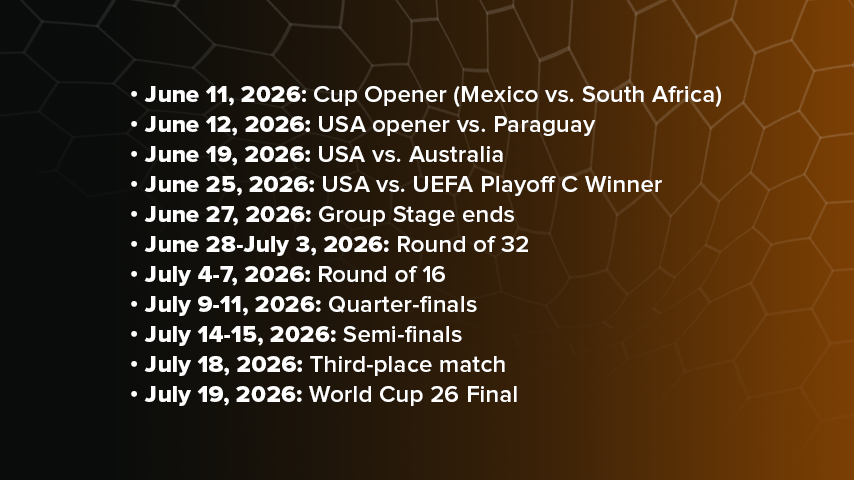
Key Dates Timeline
Mark these critical dates in your calendar to stay ahead of the World Cup ticketing process.
Quick Money-Saving Tips & Mistakes to Avoid
The tournament is already creating a lot of buzz. Hence, it would be smart to start with preparations for the World Cup by making sure you have everything you need to get the tickets for the matches you want.
Here are some tips on what you should and shouldn’t do as you wait for the FIFA World Cup 2026 tickets.
DO:
- Create your FIFA ID account as soon as possible. Don’t wait for the last day of the lottery closing. That’s a tactic many players take, which often causes system crashes due to an increase in traffic. Therefore, if you can, create an account and verify it as soon as you can.
- Check the “Accept Downgrade” box. This single checkbox can make the difference between getting tickets and failing to enter the matches. Due to high demand, you might still get seats – and Category 3 seats are far better than having no seats. You can always decline allocated tickets if you find the downgrade unsatisfactory, but you can’t do anything if your application is rejected for only requesting Category 1 seats.
- Apply for multiple matches. The lottery is free to enter. That means that you can apply for more than one match – even 10, 20, or 40 matches (the maximum number allowed). Even if you only want to see one specific team, applying for other games by other teams (like Brazil vs. Morocco, Argentina vs. Algeria, or France vs. Senegal) increases your odds of winning. You can decline unwanted games or resell the tickets on FIFA’s official marketplace.
- Book refundable accommodation in advance. Major cities such as Los Angeles, New York, Miami, and Mexico City can be both quite expensive or even booked solid months in advance. That’s why it would be smarter to reserve refundable rooms as soon as possible at hotels near stadiums. If you don’t win lottery tickets, you can easily cancel the booking and find another (if you received tickets for other matches in another city).
- Consider applying for “neutral” matches. A great strategy for saving money is to attend matches between smaller nations or matches that are not as sought after. Their prices can be up to 80% cheaper than USA, England, Argentina, and Brazil games. If you are doing it for the atmosphere and the unique feeling of attending the World Cup, you can get all that without spending thousands of dollars.
DON’T:
- Wait for prices to drop. Prices never decrease. They only increase as the number of available remaining tickets dwindles and the matches draw nearer. In fact, waiting for ‘better prices’ can often lead to going home empty-handed altogether. The cheapest tickets are always the ones offered during the earliest sales phases.
- Buy from unverified sources. Scammers exist everywhere, including social media platforms such as Instagram, Facebook, and X. That’s why the best solution is to go to the verified source and purchase tickets on platforms that guarantee safety and are verified. And another thing: mobile tickets in the official FIFA app cannot be screenshotted or transferred, so keep that in mind if someone offers you a screenshot (because it’s fake).
- Assume you’ll win tickets via lottery. Winning tickets through the lottery is not guaranteed. In fact, success rates in FIFA lotteries typically run under 10% for popular matches. Don’t make plans based on match attendance until you know for sure that you have acquired the tickets that you wanted. And if you do make plans in advance, make sure you have a backup plan just in case.
- Book non-refundable travel and accommodation in advance. if you’re not sure if you are going to get the tickets, it does not make sense to book flights and This seems obvious but catches thousands of fans every tournament. You get excited about seeing USA play, book $1,200 in flights to Los Angeles, then don’t win tickets. Now you’re scrambling for secondary market tickets at 3x face value to justify your trip. Always tickets first, travel second.
- Expect $60 tickets. Please keep in mind that you’re not very likely to get $60 tickets. No matter how devoted of a fan you are or how many games you are attending, the demand is simply too big to cater to everyone. That’s why it’s better to prepare for a higher pricing and costs for your desired matches, starting from $300-$600 for group matches and at least $1,000+ for games in the subsequent phases.
Frequently Asked Questions
How much do FIFA World Cup 2026 tickets cost?
The World Cup tickets for 2026 typically range from $60 to $6,730 depending on the tournament round and seating category. For example, group stage tickets start at $60 for Category 4 seats and reach $620 for Category 1. Knockout rounds tend to be significantly higher, with quarterfinals ranging from $150-$1,500, semifinals from $200-$2,500, and the final from $300-$6,730. However, USA games are higher because there’s high demand. The cheapest USA opener tickets starting around $2,735.
When do World Cup 2026 tickets go on sale?
The current Random Selection Draw lottery phase runs from December 11, 2025, through January 13, 2026, with results announced in February 2026. Following this, Bank of America cardholders get presale access on February 10, 2026. The general first-come, first-served sale opens in spring 2026 (exact date TBA).
Where is the 2026 World Cup Final?
The 2026 FIFA World Cup Final takes place at MetLife Stadium in East Rutherford, New Jersey, on July 19, 2026, with a 3:00 PM ET kickoff. This timing allows for prime-time viewing in Europe (9:00 PM) and the United Kingdom (8:00 PM). MetLife Stadium, located about 8 miles from Manhattan, seats 82,500 fans and previously hosted Super Bowl XLVIII. The venue was selected over other finalists including AT&T Stadium in Dallas.
What US cities are hosting the Cup?
The 2026 Cup is going to be hosted in eleven US cities: New York/New Jersey, Los Angeles, Dallas, Atlanta, Miami, Seattle, San Francisco Bay Area, Houston, Kansas City, Philadelphia, and Boston. The United States will host 78 of the tournament’s 104 total matches, including all games from the quarterfinals onward.
How do I enter the FIFA ticket lottery?
The process is quite easy. First, create a free FIFA ID account at FIFA.com/tickets. Once registered, log in during the Random Selection Draw period (December 11, 2025 – January 13, 2026) and select which matches you want to attend, choosing your preferred ticket category (1-4) and quantity (up to 4 per match, maximum 40 per household). You need to submit the application before January 13. In February, the winners will be announced, and if you did not get anything you want, you can resell or purchase tickets on TicketCenter, FIFA marketplace, or last-minute sales phase on FIFA.
Can I buy World Cup tickets on TicketCenter?
Yes, the tickets eventually appear on secondary markets like TicketCenter and other marketplaces. You can purchase tickets directly at our website easily. The World Cup tickets for 2026 are mobile-only, and they are not available for printing or transferring (or screenshotting).
What is the cheapest World Cup ticket?
The cheapest World Cup tickets for 2026 are priced at $60 for Category 4 seats. However, due to their limited offer, they are almost unattainable. For the general public, the most common pricing level starts at $140-$250 for Category 3 seats at less popular group stage matches.
How many tickets can I buy?
Each household can purchase a maximum of 40 tickets total for the entire tournament, with a limit of 4 tickets per individual match. According to FIFA, a “household” counts as the postal address in your ticketing account. Hence, you and your family members can technically get up to 4 tickets per that address.
Are $60 World Cup tickets real?
Yes, $60 tickets exist but are virtually inaccessible to the general public. FIFA announced this price tier for national team supporters because they were heavily criticized for the high cost of tickets. However, each game gets allocated only around 400-500 tickets, which is distributed to qualified supporters nearly instantly. Therefore, it’s not going to be easy to get those cards and you should not count on them at all. It’s better to be prepared to dish out a higher sum for the tickets.
When does USA play in the 2026 World Cup?
The USA plays three group stage matches in June 2026: June 12 vs. Paraguay at SoFi Stadium in Los Angeles, June 19 vs. Australia at Lumen Field in Seattle, and June 25 vs. the UEFA Playoff C Winner, again at SoFi Stadium in Los Angeles. If the USA advances from the group stage, knockout round matches begin June 28. The exact opponents depend on the final standings once the group stage is finished.
Conclusion
For many, a chance to attend a World Cup game is a once-in-a-lifetime opportunity. It’s soccer’s greatest tournament ever, and this year will surely be a spectacle, thanks to the 48 teams, 104 matches, and 16 incredible host cities across North America.
Whether you’re determined to see the US team at SoFi Stadium, witness what could potentially be Messi’s last World Cup, or just enjoy the magic of soccer, one thing is certain – you need to buy World Cup tickets as soon as possible.
We are still very far from the actual matches, but the anticipation for the World Cup 2026 has already started. This historic tournament is not something you’d want to miss.